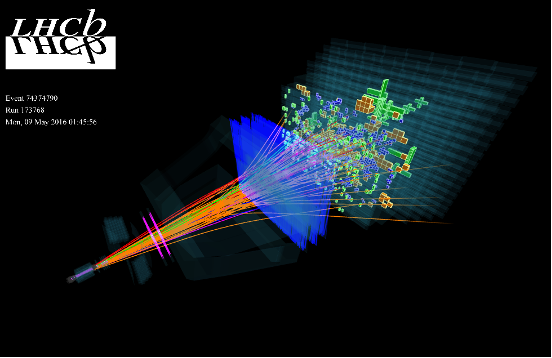
The research group from the Department of Experimental Particle Physics (F9) at the Jožef Stefan Institute has been confirmed as a full member of the LHCb collaboration. With the LHCb detector at CERN, the group performs highly precise measurements to test the predictions of the Standard Model in the decays of heavy particles. This acceptance represents recognition of the group’s long-standing successful research in the field of flavour physics within the Belle and Belle II experiments, as well as their expertise in the development of ring-imaging Cherenkov (RICH) detectors and photon detectors, which are essential for precise particle identification.
The acceptance further strengthens the long-term involvement of Slovenian researchers in particle physics research, during which they have made significant contributions to the development of experimental methods and detector technologies. The activities of the Department cover three key research frontiers of modern physics: the energy frontier, the precision frontier, and the cosmological frontier. All research is carried out within major international collaborations, including ATLAS and LHCb at CERN in Geneva, Belle II in Japan, the Pierre Auger Observatory in Argentina, and the Cherenkov Telescope Array Observatory in Chile and La Palma.
Last year, Slovenia became a full member of CERN, thereby gaining co-ownership of one of the most important research infrastructures in the world. This has also increased the responsibility of Slovenian researchers for the development, construction, operation, and maintenance of detector systems for future experiments.
With the acceptance as a full member of the LHCb experiment, the role of the Jožef Stefan Institute and the Slovenian physics community in the development of global research infrastructures is further strengthened. Joining the LHCb collaboration enables deeper involvement in analyses of flavour physics processes with heavy quarks, and further enhances the excellent collaboration with theoretical physicists at the Department of Theoretical Physics (F1).